
Food, electricity, heat and water within one interconnected system: BIOTOPE opens up possibilities far beyond the individual greenhouse. A conversation about what could grow from this idea.
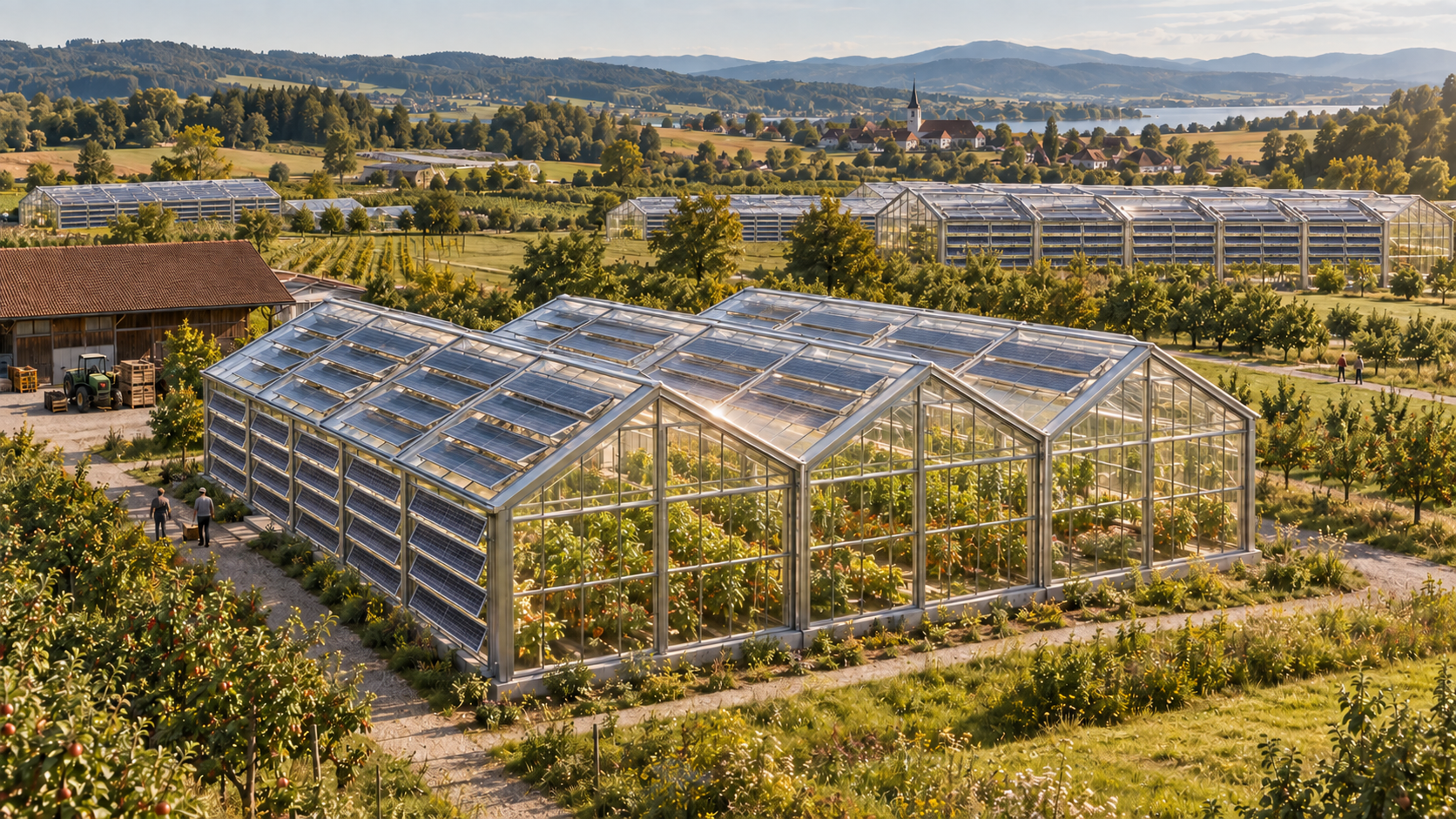
Once you begin to understand BIOTOPE, it is almost impossible not to think further. If an envelope can protect plants, harness solar energy and keep water circulating, what could many such structures achieve together? For a region, a country and the people who live there?
It begins on a small scale. A BIOTOPE prototype of around 20 m² already exists, and its basic functions have been demonstrated in practice. The next step is to develop larger installations that can be reliably reproduced.
But the idea invites us to look further ahead: what would happen if a substantial share of our food were grown inside structures whose envelopes also produced electricity and heat?
Agricultural land would become part of our energy supply. Food production, water management and energy generation would move closer together. Functions that are often spread across separate facilities could complement one another within a shared system.
A greenhouse has more surface area than the ground on which its plants grow. Its roof and sides form a three-dimensional envelope. That is where an interesting opportunity emerges.
For an initial model, we assume three hectares of total envelope area for every hectare of cultivation area. Of these, we consider two hectares potentially suitable for energy generation. Assuming 80% technical usability leaves 1.6 hectares of active solar surface for every hectare under cultivation.
If we allocate 70% of that active surface to photovoltaics and 30% to dedicated solar thermal collectors, we arrive at 1.12 hectares for electricity generation and 0.48 hectares for heat production.
The envelope becomes a productive surface in its own right. Food grows beneath it, while sunlight is put to work within it.
Let us take 2.5 million hectares as a provisional reference area representing a substantial share of plant-based food production. If BIOTOPE structures covered 10% of this model area, that would amount to 250,000 hectares under cultivation.
This is an enormous scale. Here, it serves to make the dimensions of the idea tangible.
Using the assumptions above, it would provide 400,000 hectares of active solar surface: 280,000 hectares of photovoltaics and 120,000 hectares of solar thermal collectors.
With assumed annual yields of 180 kWh of electricity per square metre of PV surface and 400 kWh of useful heat per square metre of solar thermal surface, the calculation gives:
The scenarios covering 20%, 30% and 40% of the assumed reference area scale accordingly:
| Share of the model area | BIOTOPE cultivation area | Annual electricity | Annual heat |
|---|---|---|---|
| 10% | 250,000 ha | 504 TWh | 480 TWh |
| 20% | 500,000 ha | 1,008 TWh | 960 TWh |
| 30% | 750,000 ha | 1,512 TWh | 1,440 TWh |
| 40% | 1,000,000 ha | 2,016 TWh | 1,920 TWh |
These scenarios are not deployment plans. They show why it is worth exploring the combined use of sunlight, land and growing space on a larger scale.
Yes. For comparison, the figures cited in the source document put Germany’s gross electricity consumption in 2025 at around 528 TWh. The modelled 504 TWh would be equivalent to approximately 95% of that annual total.
That does not mean electricity would be available whenever it was needed. But it does reveal the scale of the potential contribution.
The land comparison is equally revealing: the 250,000 hectares in the smallest scenario represent around 1.5% of Germany’s approximately 16.6 million hectares of agricultural land.
The “10%” in our calculation therefore refers specifically to the assumed reference area of 2.5 million hectares. And the active solar surface is formed by the envelopes themselves — it does not require an equivalent additional area of land.
That is central to the idea.
The growing environment should provide conditions that can be adapted to different crops. Light, temperature, humidity and air movement work together. Vegetables, berries, delicate fruits and other suitable crops could grow in areas managed around their particular needs.
This also opens up new regional possibilities. Which foods could we grow closer to the people who eat them? Which crops would benefit from a protected, carefully regulated climate?
Subtropical and tropical fruits belong in this discussion too. Where suitable conditions can be created sensibly, they could add to the range of locally grown food. The most appropriate species would depend on the location and their individual requirements.
The exciting prospect is an agriculture that deliberately shapes its growing environments while integrating the energy and water functions they need.
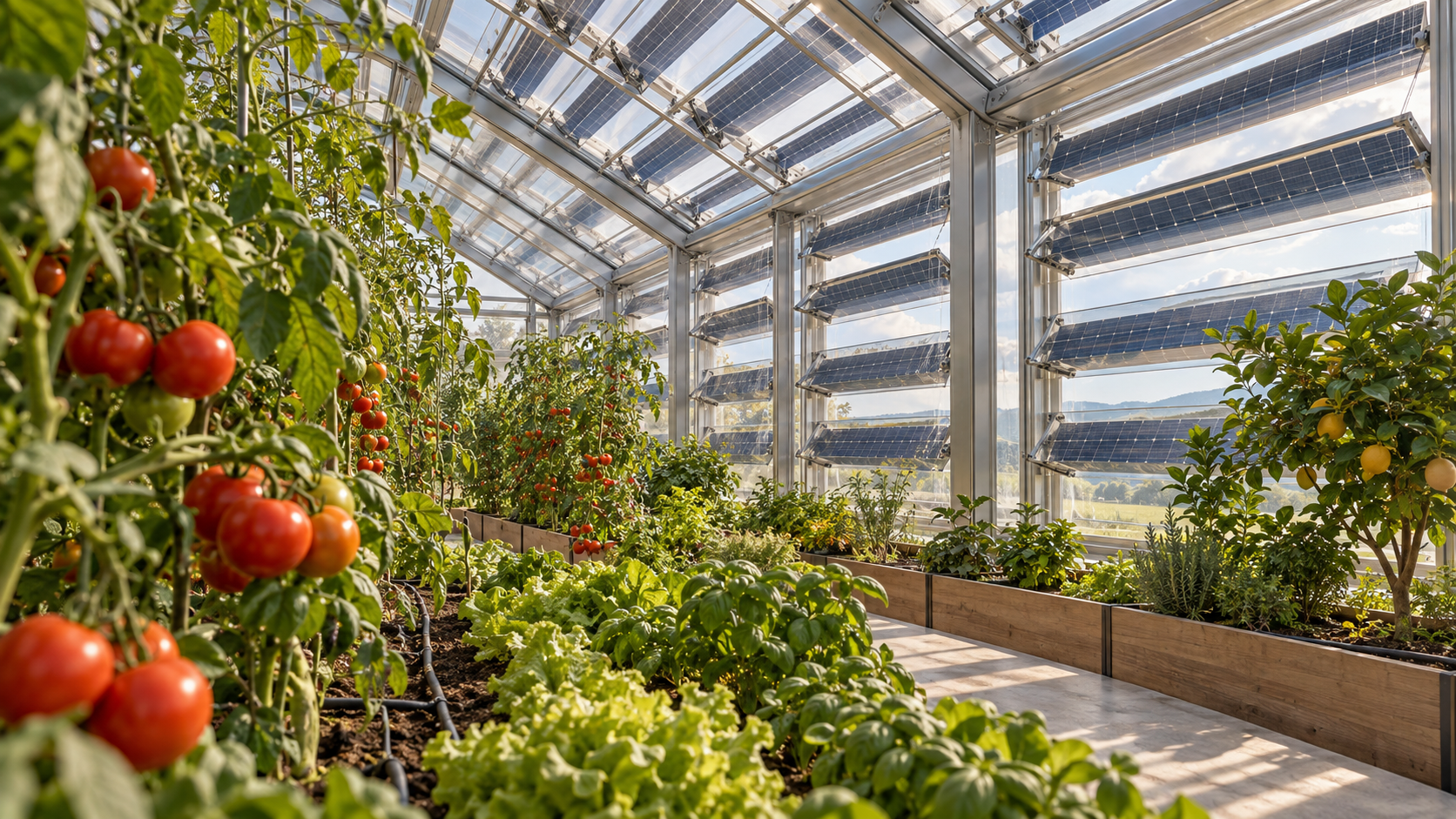
Much of it becomes heat. BIOTOPE aims to make use of that energy too.
Air flowing through the channels passes around the PV louvers, absorbs heat and rises. A heat exchanger can transfer this energy to water — for use within the installation itself, for cleaning, showers or other nearby applications.
The same process serves several purposes: the louvers are cooled, heat is transported, and another useful form of energy becomes available.
Heat recovered from the PV louvers is not included in the solar thermal figures above. Further development will establish how much additional useful heat can be captured.
Here we return to a guiding idea behind BIOTOPE: make the fullest possible use of sunlight by connecting its different effects.
Yes — and this change of roles is one of the most fascinating aspects of the system.
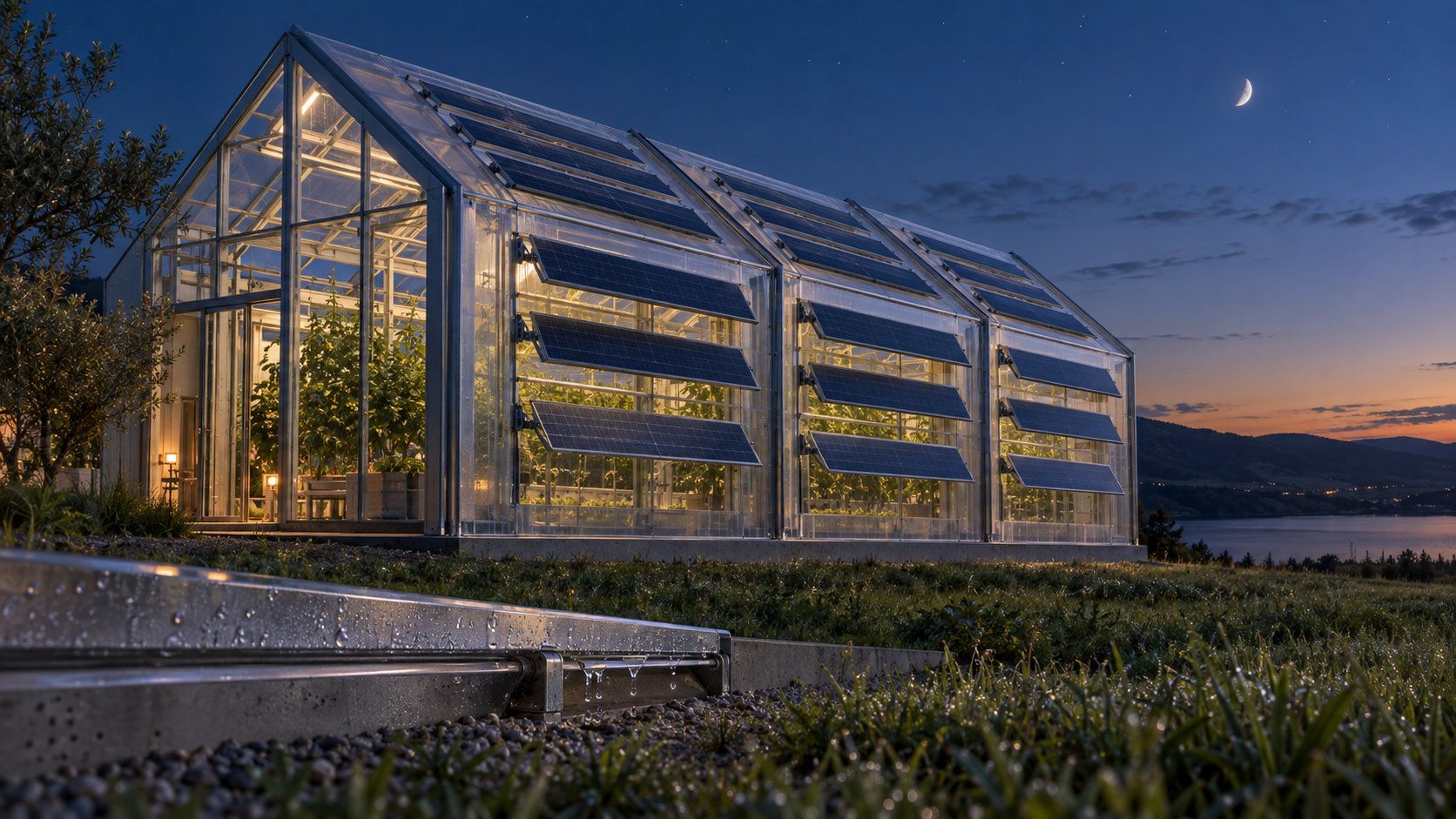
Under suitable conditions, the envelope can radiate heat towards the sky at night and cool down. The model considers around 100 watts of cooling power per square metre as a favourable design value. Actual performance depends on factors including cloud cover and humidity.
With heat exchangers and, where appropriate, storage, this cooling can be used to condense water vapour. Some of the water released by plants during the day could then be recovered.
Plant growth, transpiration, night-time cooling and water recovery become parts of a local cycle. For regions where water is scarce and precious, this offers a particularly important possibility.
The growing environment remains active, while the system’s priorities shift with the available light.
On darker days, light for plants comes first. When sunshine is stronger, electricity generation and heat recovery can contribute again. Stored heat and, where necessary, supplementary lighting can support crops that need warmer conditions.
The basic pattern is straightforward:
Less sunshine: light for plants.
More sunshine: light for plants, electricity and heat.
At night: cooling and water recovery, where conditions allow.
Storage expands these possibilities. Batteries can help balance short-term fluctuations in electricity. Large water-based thermal stores — the “Hot Lakes” — could hold heat for later use.
This suggests a system that works with the rhythms of day and night, summer and winter, adjusting its functions as conditions change.
That is an important design question. Larger BIOTOPE structures should consider the growing environment and the surrounding landscape together.
Lightweight, articulated envelopes could be adapted to different terrain and crops. Repairability, long service life and economical use of materials are part of the development approach.
The biomass produced also opens up further possibilities. Some of it could become fibres, insulation or durable building components.
The perspective therefore extends beyond a single harvest. Agriculture, energy supply and regional manufacturing could become more closely connected.
Trade and exchange between regions remain valuable. At the same time, we can ask which foods could be grown to a high standard closer to where they are consumed.
Fewer unnecessary journeys and more locally created value would be potential benefits. This transition should be shaped together with the people whose livelihoods depend on existing supply chains.
Access to the technology is therefore part of the vision. Regions that currently grow flowers or fruit for export should have the same opportunities to develop their own supplies of food, electricity, heat and water.
Local autonomy and international cooperation can strengthen one another.
That a good quality of life does not have to demand ever-greater inputs of energy and resources.
When one envelope performs several functions, heat is reused, water stays in circulation and food grows close to the people who need it, many individual improvements can combine into a much larger effect.
Jürgen Kleinwächter’s Generalized Fermat Principle offers a guiding question: How can we enable the greatest possible quality of life with the least necessary input of primary resources?
BIOTOPE brings this idea into a tangible living environment. Nature provides the inspiration: its structures protect, supply, regulate and exchange — often simultaneously, and with remarkably little material.
By giving the development room to grow.
The small prototype already exists. A larger demonstrator is planned in Germany to prepare the way for industrial implementation. The proposed 2,000 m² installation with Muni Seva Ashram in India then offers a concrete prospect for a larger application.
This calls for people from agriculture, research, industry and energy to build, learn and develop the system together.
We do not need to design a complete nationwide system today to take its potential seriously. We can begin with a manageable installation while keeping the larger possibility in view.
The seedling is here. Now we need to give it the conditions to grow.